

Table of Contents
- What Makes a 10,000 Islands Boat Tour Worth Booking
- How to Compare 10,000 Islands Boat Tours Side by Side
- Private Boat Charter Marco Island: What You Get When You Go Custom
- The 10,000 Islands Shelling Tour: Where the Good Shells Actually Wash Up
- Best Time of Day for Dolphin Watching Near Marco Island
- Ten Thousand Islands Sunset Cruise: Why Evening Trips Feel Different
- Which 10,000 Islands Boat Tour Fits Your Crew
- What to Bring and What to Expect Onboard
- Booking Details, Weather, and Wildlife Expectations
- Frequently Asked Questions
Last Updated: October 13, 2026
What Makes a 10,000 Islands Boat Tour Worth Booking
The best 10,000 islands boat tours do two things at once: they get you into water most people never see, and they hand you a captain who actually knows what’s out there. That combination is harder to find than it sounds.
The Ten Thousand Islands is a maze of mangrove islands, shallow bays, and barrier beaches stretching along Southwest Florida’s coast. Much of it sits inside Ten Thousand Islands National Wildlife Refuge, where the rules protect nesting birds, sea turtles, and the seagrass beds that feed everything else. A good tour respects that. A great one teaches you why it matters.
At Florida Island Tours, we run captain-led trips out of the Marco Island and Goodland area, and we’ve learned that the difference between a memorable day and a forgettable one usually comes down to three things: how many people are on the boat, where the captain chooses to go, and whether anyone aboard can tell you what you’re looking at.
Keep reading, because the tour you pick should match the day you actually want.
Private Charters vs. Shared Trips: The Real Difference
A private charter is your group’s boat, your schedule, and your call on where to linger. A shared trip is a set departure, a fixed route, and a lower per-person rate.
That’s the trade in plain terms. Shared trips work well for couples and solo travelers who don’t mind company and like a set itinerary. Private charters suit families, photographers, and anyone who wants to stay an extra twenty minutes at a sandbar because the light is perfect.
Here’s what most people don’t realize: on a shared tour, the route is usually locked before you board. On a private charter, the captain can read the tide, the wind, and the wildlife and change plans mid-trip. Around here, that flexibility is often the whole point.
Ask about group size before you book anything. A “small group” tour can mean anything from six passengers to thirty. Ours cap at twelve on private and specialty trips, which changes how much you actually see.
How to Compare 10,000 Islands Boat Tours Side by Side
Most lists of 10,000 Islands boat tours read the same way: a name, a duration, a short blurb. That’s fine for browsing, but it doesn’t help you actually choose. The comparison that matters is the one built around your group, your priorities, and the conditions on the day you go.
Here’s the framework we’d use if a friend called and asked which trip to book.
Start With the Four Variables That Actually Change the Trip
Every tour on the water comes down to four things. Get these on paper next to each other and the decision gets much easier.
- Duration. A 90-minute trip rarely gets past the near islands. Two hours can reach a barrier beach. A 3.5-hour excursion opens up the remote stretches where the shelling and the birding get good.
- Route. Some captains run the same loop every day. Others build the trip around tide, wind, and what’s moving. Ask directly: “Where do you actually go, and does it change with conditions?”
- Group size. A “small group” tour can mean anything from six passengers to thirty. Fewer people means more room to move, better sightlines for photos, and a captain who can answer questions without shouting.
- Inclusions. Does the trip include a beach stop, shelling time, water, a naturalist guide? Those details separate a boat ride from an actual tour.
Match the Trip to the Traveler
This is the part most comparison articles skip. The best tour for a photographer is rarely the best tour for a family with a four-year-old, and neither is the best tour for someone with one free afternoon.
- Families with young kids: a two-hour island tour with a beach stop. Short enough to hold attention, with sand time to burn off energy.
- Couples: a sunset cruise or a private charter with a relaxed pace and no fixed schedule.
- Shell collectors: a 3.5-hour shelling excursion timed to a falling tide, ideally after a recent front has stirred things up.
- Photographers: a private charter, so you can wait for light and wildlife instead of watching the clock.
- Birders: an early-morning trip into the mangrove estuaries, when herons, egrets, ospreys, and roseate spoonbills are most active.
- First-time visitors: a standard two-hour tour for a broad introduction to the ecosystem.
- Groups of friends: a private charter that splits the cost and gives everyone a say in the route.
- Visitors with limited time: a 90-minute harbor cruise still gets you on the water, past the mangroves, and into dolphin territory.
A Quick Comparison Framework
Use this as a starting point when you’re weighing options. The specifics vary by operator, so confirm the details before you book.
| Trip Type | Typical Duration | Best For | What to Expect |
|---|---|---|---|
| Quick harbor cruise | 90 minutes | Families with small kids, limited time | Dolphins, birds, close-in scenery |
| Standard island tour | 2 hours | First-time visitors | Wildlife viewing, one beach stop |
| Extended excursion | 3.5 hours | Shellers, photographers, birders | Multiple stops, backcountry routes |
| Private charter | Flexible | Groups wanting control | Custom route, custom pace |
| Sunset cruise | 2 hours | Couples | Golden-hour views, calmer water |
The Questions Worth Asking Before You Book
A short phone call or email to the operator answers more than any listing page. Here’s what we’d ask:
- How many guests are on a shared trip, and how many on a private charter?
- Does the route change with tide and weather, or is it fixed?
- Is there a beach stop, and how long do you spend ashore?
- Who’s driving, a captain only, or a captain plus a naturalist guide?
- What’s the cancellation and rescheduling policy if weather turns?
- What should we bring, and what’s provided on board?
If you’re torn between two options, pick the longer one. Almost nobody finishes a trip wishing they’d spent less time on the water.
Private Boat Charter Marco Island: What You Get When You Go Custom
A private boat charter out of Marco Island gives you the boat, the captain, and the itinerary. You decide whether that means a shelling run to a remote beach, a slow cruise through the mangroves, or a sunset trip with nowhere in particular to be.
This is where custom trips earn their keep. Maybe your kids want to hunt for shells. Maybe you’d rather spend an hour watching ospreys work the shallows. Maybe someone in your group isn’t a morning person, and a late-afternoon departure just fits better.
We build trips around the group in front of us. Our US Coast Guard certified master captains and University of Florida certified Master Naturalist guides ensure every tour is packed with personalized insights into local history and wildlife, which means the person pointing out a manatee can also tell you why it’s there and what it’s eating. Deepening your connection to these ecosystems requires a broader perspective on the region, so we have curated a deeper collection of Southwest Florida travel insights to help you better understand the complex environment surrounding our waterways.
What you won’t get is a scripted narration over a loudspeaker. That’s a different kind of trip, and it’s fine, but it isn’t this one.
The 10,000 Islands Shelling Tour: Where the Good Shells Actually Wash Up
The best shelling happens on beaches most boats can’t reach, at the right tide, after the right weather. That’s the honest answer, and it’s why a shelling tour is really a timing tour.
Barrier islands like Kice Island and Dickman’s Island collect what the Gulf pushes in. A falling tide exposes the freshest stretch of sand. A recent storm can turn up species you’d never find on a calm week. A quiet beach with no footprints on it is worth more than a famous one that’s been picked over since sunrise.
What we look for, and what you can learn to spot:
- Lightning whelks and horse conchs, often just below the tide line
- Sand dollars, usually in the shallow wash where the sand stays wet
- Shark teeth, small and dark, easy to miss if you’re walking fast
- Olive shells and scallops, common but satisfying to find intact
One rule matters more than any tip: if something is alive in the shell, it goes back. That’s not just good manners. It’s how the beach keeps producing.
Walking past the first twenty feet of beach is the most common mistake. The good stuff usually sits further up, where the last high tide stopped. Slow down and look at the wrack line.
Best Time of Day for Dolphin Watching Near Marco Island
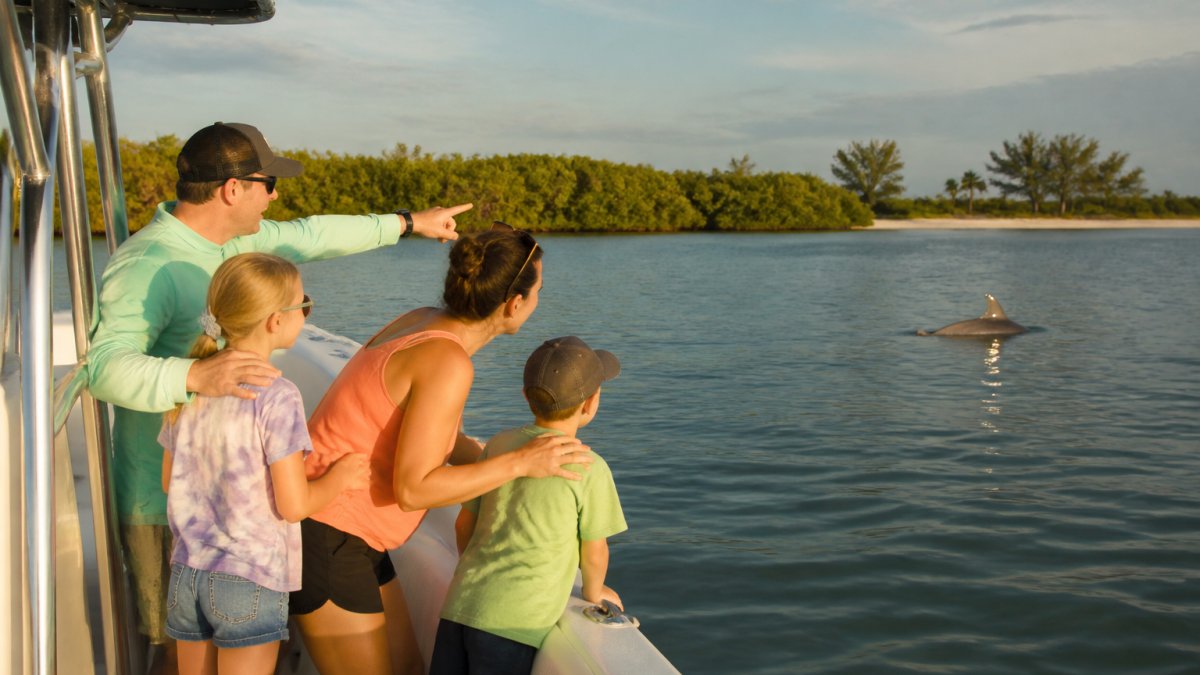
Early morning and late afternoon are the best windows for dolphin watching near Marco Island. The water is calmer, boat traffic is lighter, and dolphins tend to be more active during feeding periods.
Midday works too, but the wind picks up, the chop builds, and the animals get harder to track. If dolphins are the priority, book the first trip out or the last one before sunset.
A few things worth knowing about the dolphins you’ll see:
- They’re wild. Nobody can promise a sighting, and any operator who guarantees one is overselling.
- They often follow boats and ride the wake, which is a thrill to watch and completely their choice.
- Feeding happens on their schedule, not ours. The best trips stay flexible and go where the activity is.
Our captains have spent years on these waters and know the spots where dolphins commonly feed. That improves your odds. It doesn’t turn a wild animal into a scheduled attraction, and we’d rather be straight with you about that.
Ten Thousand Islands Sunset Cruise: Why Evening Trips Feel Different
A Ten Thousand Islands sunset cruise trades the heat of the day for golden light, cooler air, and water that flattens out as the wind drops. The whole character of the islands changes.
Mangroves go from green to copper. Pelicans and herons head for their roosts. The horizon opens up over the Gulf, and the ride home happens under a sky that makes everyone go quiet for a minute.
Evening trips suit couples, photographers, and anyone who’d rather end the day on the water than in a restaurant. They’re also a genuinely different experience from a daytime tour, not just the same route with worse visibility.
Which 10,000 Islands Boat Tour Fits Your Crew
Match the trip to the people, not the other way around. Here’s how we’d sort it:
- Families with young kids: a two-hour island tour. Short enough to hold attention, with a beach stop to burn off energy.
- Couples: a sunset cruise or a private charter with a relaxed pace.
- Shell collectors: a 3.5-hour shelling excursion timed to a falling tide.
- Photographers: a private charter, so you can wait for the light and the wildlife.
- First-time visitors: a standard two-hour tour for a broad introduction to the ecosystem.
- Groups of friends: a private charter that splits the cost and gives everyone a say.
If you’re torn between two options, pick the longer one. Almost nobody finishes a trip wishing they’d spent less time on the water.
What to Bring and What to Expect Onboard
Pack for sun, water, and a little spray. Even on a calm day, a boat moves, and Southwest Florida’s sun doesn’t negotiate.
Bring:
- Sunscreen, a hat, and sunglasses with a strap
- A light long-sleeve layer for wind on the ride out
- Water and snacks, especially on longer trips
- A camera or phone in a waterproof case
- A soft bag or small cooler, since space is limited on smaller boats
- Motion sickness medication if you’re prone to it, taken before you board
Leave behind:
- Hard-sided coolers and bulky luggage
- Glass containers
- Anything you’d hate to get wet
Expect to get your feet sandy if there’s a beach stop. Expect the captain to slow down for wildlife. Expect a safety briefing before you leave the dock, because that part isn’t optional.
The single biggest comfort upgrade on any 10,000 Islands boat tour is a hat and a wind layer. Sun and wind do more to wear people out than the heat itself.
Booking Details, Weather, and Wildlife Expectations
This is the section most tour articles gloss over, and it’s the one that decides whether your day on the water goes smoothly. Here’s the honest version.
When to Book
Book early for sunset trips, private charters, and anything on a weekend or holiday. Those slots fill first, and waiting until the day before usually means settling for whatever’s left. Weekday mornings are the easiest to grab on short notice, and they’re also some of the best conditions of the day.
If you have a specific date in mind, a birthday, an anniversary, a visiting relative’s only free afternoon, lock it in as soon as you know. If your dates are flexible, a midweek trip gives you more options and a quieter experience on the water.
How Season, Tide, and Weather Shape the Trip
Southwest Florida has two rough seasons, and they fish very differently.
- Dry season (roughly November through April): cooler air, lower humidity, clearer water, and lighter boat traffic. This is prime time for shelling, birding, and comfortable all-day trips. Mornings can be breezy, so a light layer helps.
- Wet season (roughly May through October): warmer water, afternoon thunderstorms, and the best manatee and dolphin activity of the year. Mornings are usually calm and clear; the sky builds after lunch. If you’re booking in summer, an early departure is almost always the smarter call.
Tides matter just as much as season. A falling tide exposes the freshest stretch of beach and concentrates shells along the wrack line. A rising tide pushes fish and dolphins into the shallows to feed. A good captain plans the route around the tide chart, not against it.
Wind is the wild card. A 10-knot breeze is a pleasant day on the Gulf. Twenty knots turns the backcountry choppy and pushes captains toward sheltered mangrove creeks. Either way, there’s a good trip to be had, it just might not be the one you pictured.
Weather Cancellations and Rescheduling
Afternoon thunderstorms are a real feature of summer here, and captains watch the radar closely. If a trip gets called for weather, that’s a safety decision, not a customer service one.
Ask about the cancellation and rescheduling policy before you pay, so you know where you stand. Most operators will reschedule rather than refund when weather forces a cancellation, and the specifics, how far in advance, what counts as unsafe, whether you can move to another date, vary. Get it in writing or in an email confirmation.
A few practical notes:
- Lightning is the hard stop. If there’s lightning within a certain radius, no reputable captain leaves the dock.
- Rain alone usually isn’t a cancellation. A passing shower in the mangroves is part of the experience.
- Small craft advisories are a real signal. If one is posted, expect the trip to be moved or called.
Wildlife Expectations, Honestly
Wildlife is wild. We see dolphins on most trips and manatees less predictably, and we never promise either. What we can promise is a captain who knows where to look, a guide who can explain what you’re seeing, and a route built around the conditions on the day you go.
A few things worth knowing:
- Dolphins are curious and often approach boats on their own. They may ride the wake, or they may ignore you entirely. Both are normal.
- Manatees are most visible in warm water, spring and summer, and often in the calmer backcountry creeks. They surface briefly and quietly, so slow down and keep your eyes on the water.
- Shorebirds, herons, egrets, ospreys, roseate spoonbills, are most active in the first few hours after sunrise and the last hour before sunset.
- Sea turtles surface to breathe and are usually seen from a distance. Keep your distance and let them be.
Never feed, touch, or chase wildlife. It’s illegal for marine mammals, and it’s bad for the animals even when it isn’t. The Florida Fish and Wildlife Conservation Commission publishes clear guidance on wildlife viewing and shell collecting that’s worth a read before you go.
Responsible Shelling, in Plain Terms
One rule matters more than any tip: if something is alive in the shell, it goes back. That’s not just good manners. It’s how the beach keeps producing. Live shells, sand dollars with visible movement, and anything still attached to the sand stays put. Empty shells are fair game, and the ones you find on a quiet barrier island after a falling tide are the ones you’ll actually remember.
Accessibility and Comfort
If anyone in your group has mobility concerns, ask before you book. Smaller boats can be harder to board than they look, and beach stops involve stepping off into shallow water. Captains who know their boats well can tell you exactly what to expect and whether a private charter is a better fit than a shared trip.
For current trip options and availability, our boat tours page lays out what we run.
Frequently Asked Questions
What wildlife might you see on a 10,000 Islands boat tour?
The Ten Thousand Islands National Wildlife Refuge and surrounding waters are home to bottlenose dolphins, manatees, ospreys, herons, egrets, roseate spoonbills, and occasional sea turtles. Dolphins often surface near moving boats, and manatees tend to appear in calmer, warmer shallows. Wildlife is wild and unpredictable, so no captain can promise a specific sighting on any given trip. Morning departures and quieter channels generally give you the best odds of seeing animals behaving naturally.
Is a private boat charter or a shared tour better for exploring the 10,000 Islands?
It depends on your group. A private boat charter Marco Island style gives you full control over the route, pace, and stops, which suits families with young kids, photographers, or anyone wanting a shelling beach all to themselves. Shared trips cost less per person and work well for couples or solo travelers who don’t mind a set itinerary. If your group has mixed interests or you want to linger somewhere, private is usually worth it.
What is the best time of day for dolphin watching near Marco Island?
Early morning and late afternoon tend to be the most productive windows. Dolphins are active during cooler, calmer hours, and boat traffic is lighter, so animals are less likely to be disturbed. Midday heat pushes both dolphins and their prey into deeper or shadier water. That said, dolphins feed on their own schedule, and sightings happen throughout the day. A captain who knows the local channels can read conditions and adjust the route accordingly.
What should you bring on a 10,000 Islands boat tour?
Pack sunscreen, a hat, sunglasses, and a light long-sleeve layer for sun and wind. Bring a refillable water bottle, a small bag for shells, and a towel if you plan to wade ashore. Polarized sunglasses help you spot dolphins and manatees below the surface. Non-spray sunscreen is easier to apply on a moving boat, and a dry bag keeps phones and cameras safe. Wear shoes you don’t mind getting wet or sandy for beach stops.